The United States The Bilateral Commerce Framework with Malaysia is Changing
- Feb 26, 2026
The United States The Bilateral Commerce Framework with Malaysia is Changing
For a long time, trade between the U.S. and Malaysia was primarily based on the fact that Malaysia is a major player in electronics and manufacturing networks, while the U.S. is strong in services, energy, and high-value capital products.
The trade structure that is currently directly affecting the relationship is what altered in 2025–2026. This framework goes beyond general talk and makes clear what is expected in terms of market access, compliance, and security alignment.
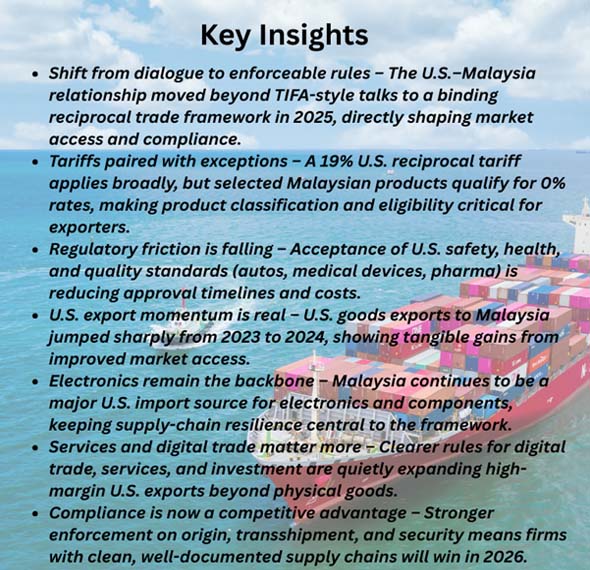
As per USA Import Data by Import Globals, the Trade and Investment Framework Agreement (TIFA) was a long-standing means for Malaysia and the US to negotiate about trade. But in late 2025, things changed when they signed a legally binding Agreement on Reciprocal Trade. This made the relationship more structured and enforceable. This agreement and the reasons behind it are now altering how businesses set prices, plan where to source supplies, estimate regulatory risk, and explore for new opportunities in both markets.
A Link That Goes From "Trade Flows" to "Trade Rules"
The new framework is not a typical full free trade deal. Instead, it puts together:
- Tariff and preference promises,
- Getting rid of important non-tariff barriers,
- Digital, service, and regulatory obligations, and
- Economic-security cooperation, include enforcing duty evasion and export controls and making investments safe.
- A main point is that the U.S. charges a 19% duty on goods from Malaysia, but certain products on a list of exceptions are not charged any tariffs. As per USA Trade Data by Import Globals, the deal makes it clear that Malaysia will give "commercially meaningful" preferential market access to a wide range of U.S. exports, including industrial commodities and some types of agricultural goods.
That Framework Gives Both Sides a Strong Reason to Act:
For Malaysia : keep access to the U.S. market stable and show that you are working together on trade integrity, security, and enforcement.
For the U.S. : increase exports to Malaysia (in industries including agriculture and services) while making compliance expectations stricter (for example, on origin, standards, and duty-evasion controls).
The 2025 "Reciprocal Trade" Pivot: What It Really Means
Most of the time, commerce doesn't rise just because tariffs go down. It grows when "small frictions" that keep transactions from happening stop happening. As per USA Export Data by Import Globals, the deal clearly aims to fix those problems in the industries that are most important to U.S. exporters:
- Automotive: Malaysia agrees to accept U.S.-made cars that meet U.S. safety and emissions regulations. This cuts down on the costs of testing and certifying cars that are made in both countries.
- Health Industries: Malaysia will accept U.S. FDA certificates and previous marketing authorizations for pharmaceuticals and medical equipment. This makes it easy to fill out forms and speeds up the process of getting things approved.
- Industrial Inputs: Making it easier to secure import licenses for some U.S. steel and pipe items and getting rid of curbs on imports of remanufactured goods. As per Malaysia Import Data by Import Globals, this is very important for keeping prices low in the supply chains for industrial maintenance and equipment.
- Agriculture and Halal Processes: initiatives to speed up the export of meat, poultry, dairy, and other foods that are already recognized. For example, making halal certification and regionalization methods for managing animal diseases more predictable.
In commercial terms, this means going from "you can export" to "you can Export Reliably and at Scale."
Where the Framework First Hits: Standards, Licenses, and Problems Getting Into the Market
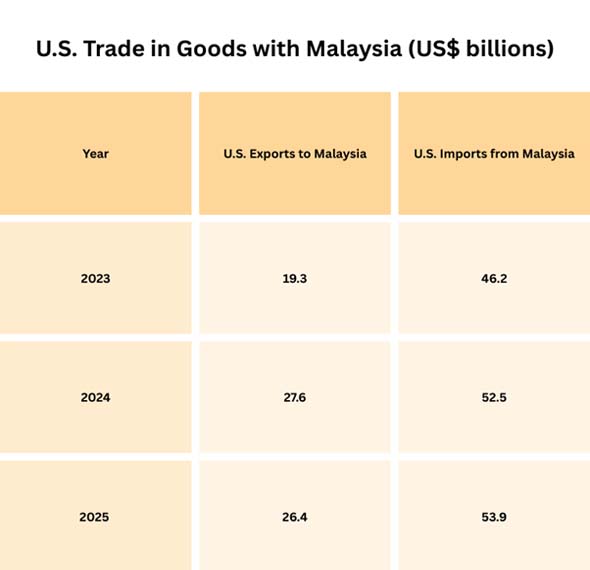
Malaysia is still an important source of imports for the U.S., especially in electronics supply chains. The U.S. is working to increase exports and reduce its ongoing trade deficits. The most recent full year totals (2024) and the most current numbers for 2025 (January to November) show the pattern of the relationship extremely clearly.
Two Factors to Keep in Mind When Planning for 2026 Are:
From 2023 to 2024, exports went up a lot, showing that U.S. businesses can grow, especially when there aren't as many rules and licenses.
As per Malaysia Export Data by Import Globals, imports are still high, therefore U.S. policy will continue to emphasis "rebalancing," supply-chain security, and the integrity of the origin.
Services that come with goods are an important part of modern trade. These include software that comes with the equipment, cloud hosting, cybersecurity, compliance advice, after-sales maintenance, licensing, and financing. The pledges in the deal for digital trade, services, investment regulations, IP, customs facilitation, and regulatory standards are crucial because they make things clearer for these high-margin layers.
For U.S. enterprises, the possibility is not only to sell to Malaysia, but also to get engaged in Malaysia's expanding industries, such as data centers and digital infrastructure.
- Services for making electronics and automating factories,
- Ecosystems of medical technology,
- Programs to modernize the energy grid.
When Malaysia's services are clearer and its digital promises are stronger, it becomes a better environment for international businesses to do business in the area. This is especially true if compliance and cross-border data operations stay the same.
Digital Trade, Services, and Investment: The Framework's "Quiet Engine"
The framework for 2025–26 links trade gains to working together on national security and the economy. In practice, that means businesses should expect: As per USA Customs Data by Import Globals, more focus on duty evasion and transshipment hazards, and more collaboration on enforcement;
- Better understanding of export controls for critical technologies;
- More careful look at investments in important areas like key minerals and critical infrastructure.
This affects what companies who work in electronics and advanced manufacturing networks need to do to stay in compliance. It also changes how suppliers record where goods come from, where they are processed in between, and how corporations "design" their supply chains to prevent legal and customs complications that could have been avoided.
Why Supply Chain Security and Enforcement Are Becoming "Trade" Issues
Focusing on key minerals, rare earths, and downstream goods is one of the most important changes in the new framework. Malaysia promises to work with U.S. partners to help these sectors grow and to avoid export restrictions that would make it hard for the U.S. to get the supplies it needs. Even if it takes a while for big amounts to show up, the tendency is clear: bilateral trade is expanding from traditional trade categories to include important industrial inputs.
This gives businesses two options:
- Investments in upstream and processing that are linked to long-term demand (permits, operating licenses, environmental restrictions, and financing).
- Downstream manufacturing that uses rare earth materials to make magnets, electronics parts, and clean-tech gear.
Critical Minerals and Rare Earths: A Fresh Support That Will Pay Off in the Long Run
If you want to design a growth strategy for U.S.-Malaysia trade in 2026–2027, the framework shows a few areas that are likely to be good opportunities:
1) Modernizing Machinery, Electrical Equipment, and Factories
Malaysia's manufacturing base is getting better, and U.S. exports do well in industrial machinery, precision equipment, and electrical systems that are very reliable. Less friction in licensing and clearer rules treatment speed up deals.
2) Medicines and Medical Devices
Accepting important U.S. regulatory documents can speed up processes and save down on the costs of having to comply with the same rules twice. For U.S. health-care exporters, the bigger reward is steady demand, which comes from hospital procurement cycles, distribution agreements, and after-sales service contracts.
3) Farming and Food That Has Been Processed
Easier certification and clearer rules for handling sanitary and phytosanitary matters. The "win" isn't just one shipment; it's developing a reliable channel that can handle seasonal changes and delays in regulations.
4) Ecosystems for Aviation, Energy, and Big-ticket Purchases
The framework's commercial "take note" items (buying planes, buying electricity, buying data center equipment, and investment flows) show a pattern: big, multi-year deals that include goods, services, and financing. Look for the ecosystem consequences in 2026, such as maintenance, parts, training, local alliances, and long-term supply contracts.
5) Supply Chains That Are Clean and Strategic
The framework helps Malaysia become a partner for resilient production by providing "trusted" electronics supply-chain capacity and grid equipment and efficiency technology. That's useful not only for selling to Malaysia, but also for building up Malaysia's ability to sell to other countries. Import Globals is a leading data provider of USA Import Export Trade Data.
What the Framework Entails for 2026: "Opportunity Zones" by Sector
No framework gets rid of risk; it changes it. The key hazards to think about for 2026 are:
- Uncertainty about tariff structures for product categories that don't get exceptions, and the difficulty of showing that they are eligible for special treatment.
- The level of compliance includes proof of origin, expectations for not breaking the rules, and customs checks.
- Technology and security alignment: export regulations and investment screening are now tied to trade benefits.
- Policy conditionality: clauses that link the connection to economic-security alignment might make long-term projects less reliable in terms of strategy. Import Globals is a leading data provider of Malaysia Import Export Trade Data.
Conclusion
The U.S.–Malaysia trade framework for 2025–2026 is changing how the two countries do business with each other in a very modern way. It does this by lowering tariffs, making rules for digital and service transactions stronger, and making sure that supply-chain security is always a part of trade results. The best way for exporters and investors to take advantage of the opportunity is to align their product strategy with the framework's "fast lanes," which are standards recognition, streamlined licensing, digital/services predictability, and strategic-sector cooperation. At the same time, they should build stronger compliance capabilities so they can operate confidently in a more enforcement-heavy environment.
FAQs
Que. Is this structure the same as a traditional U.S.–Malaysia free trade agreement (FTA)?
Ans. No. It is a legally enforceable trade deal with specific commitments, not a free trade agreement that gets rid of tariffs in all areas.
Que. What is the main tariff element that enterprises should pay attention to?
Ans. Based on the listings in the agreement, the U.S. has a 19% reciprocal tariff rate on imports from Malaysia. However, some products are exempt from this rate and get a 0% rate.
Que. Where do you think trade will increase the fastest?
Ans. Industrial machinery and electrical equipment, medical gadgets and pharmaceuticals (because of easier regulations), and agribusiness and processed foods (because of easier certification processes).
Que. What is the largest risk to businesses in 2026?
Ans. Compliance, specifically regulations of origin, enforcement against circumvention, and the paperwork needed to get special or preferential treatment.
Que. Where to get detailed USA Customs Data or Malaysia Export Data?
Ans. Visit www.importglobals.com.