Argentina's Imports in 2025–26: Chemicals, Machinery, and Industrial Inputs
- Feb 25, 2026
Argentina's Imports in 2025–26: Chemicals, Machinery, and Industrial Inputs
Argentina is noted for its exports, which include soybeans, grains, meat, and more and more minerals and energy. Imports are just as crucial for the economy to run every day.
Imports as the "Hidden Engine" of Production: A Brief Overview
As per Argentina Export Data by Import Globals, there is one key reason why Argentina's imports are the way they are in 2025–26: a lot of the country's industrial production, energy operations, agro processing, pharmaceuticals, and even modern services need foreign machinery, chemicals, parts, and specialized intermediate materials. As funding improves and imports become less tight, companies become more modern and supply chains go back to normal. When imports get stricter, production lines slow down, investment slows, and shortages extend to all sectors. Anyone who wants to know about Argentina's economy in 2025–26 needs to know what the country buys from other countries.
The Big Picture: What the Import Basket Looks Like
As per Argentina Import Export Trade Data by Import Globals, Argentina imports a lot of products that aid with making things, not only those that people wish to buy. The most common things that are brought into the country are machines and electrical equipment. After that, chemicals, transportation equipment, and finally other industrial materials like plastics, rubber, and base metals.
One way to think about this is through the Harmonized System (HS) sections that are used in official trade statistics. In 2024, the most prevalent things that came into the United States were chemicals, machinery, and electrical equipment. In the first nine months of 2025, machinery was still the biggest category, but the percentage of transport equipment rose. This is part of a cycle in which investment and production normalization bring in vehicles, parts, and capital goods.
As per Argentina Import Custom Data by Import Globals, this means that most of the things that Argentina buys from other countries are "industrial." Even things that seem to be for consumers, like vehicles, often have a strong manufacturing tie through supply chains, auto components, dealership supplies, and transportation capacity.
The Key to Building Capital: Machinery Imports
Machinery and electrical equipment are the most important things that Argentina buys from other countries. These are the items that help the economy thrive and make its technology better. This group comprises tools for factories, electrical machines, telecom and computer equipment, industrial tools, and key pieces needed for anything from creating food to running power plants.
As per Argentina Import Trade Analysis by Import Globals, there are three primary reasons why importing machinery is so crucial in 2025–26:
Pressure to Bring Industry up to Date: Companies get rid of obsolete equipment to make more and pay less for each unit.
Energy and Infrastructure Needs: Upstream and midstream energy projects need particular imported equipment such as pumps, compressors, valves, and monitoring systems.
Linking Technology and Services: Data centers, better telephony, and digitizing businesses all need electronics and electrical equipment from other countries.
As per Argentina Exporter Data by Import Globals, when the macro environment makes it easier to bring in items, like by making it easier to access foreign currency, cutting down on delays in the government, or making it easier to get trade finance, machinery imports tend to grow up quickly because all the money that was put off investing is now available.
Chemicals: The Quiet Powerhouse That Powers Many Businesses
Chemicals are the second most important thing that Argentina buys from other countries. These are pharmaceuticals, chemicals used in industry, plastics precursors, specialty inputs, agrochemicals, and fertilizers. Argentina does make some chemicals at home, but a lot of the high-purity or specialty ones still originate from other nations.
In 2025–26, chemical imports will be very important because they are part of the pharmaceutical supply chain, which includes active pharmaceutical ingredients (APIs), excipients, diagnostics, and medical-grade chemicals.
Agriculture and Food Processing: As per Argentina Importer Data by Import Globals, chemicals and fertilizers that influence the way crops grow and how they are processed.
People employ resins, coatings, industrial adhesives, and chemical intermediates in the construction and manufacturing industries. Chemicals are also important for policy and inflation since they can raise prices at home when exchange rates change or when it costs a lot to transport goods into the country.
Industrial Inputs: As per Argentina Import Trade Statistics by Import Globals, Things and Parts That Are in the Middle Keep the factories going.
Argentina imports a lot of industrial inputs, which are the parts and materials that are used to make things. Not only are these things "machinery" and "chemicals." These include things like plastics, rubber goods, base metals, and a number of other parts and accessories that keep production lines running.
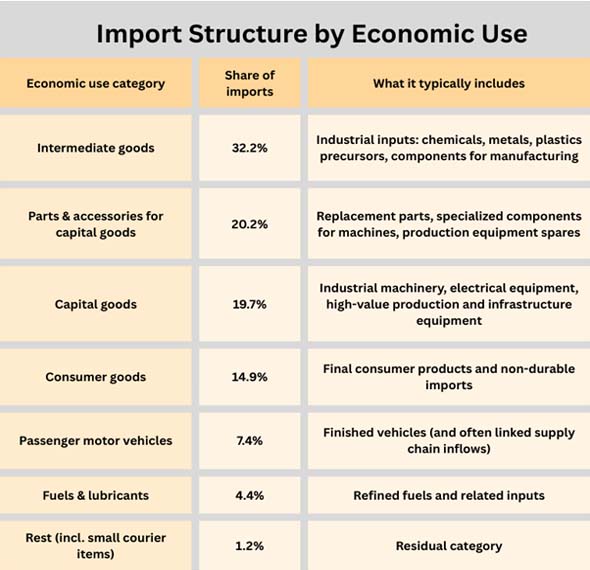
One method to talk about this structure in a way that makes sense is to utilize economic use categories, which show how imports are used in the economy. In the first eleven months of 2025, a lot of capital goods, parts, accessories, and intermediate goods were brought in. This shows that the most important things in the basket are the demands for production and investment.
Who Supplies Argentina: Partners That Show How Businesses Work Together
Argentina's trade partners also back up the "industrial input" claim. Brazil and China are the two countries that send the most goods to the United States, both in the last year and now. The US is also a big player. This goes along with Argentina entering regional manufacturing supply chains (especially for cars and industrial parts with Brazil) and getting machinery, electronics, and chemicals from all over the world (mostly from China and the U.S.).
As per Argentina Import Shipment Data by Import Globals, this mix of partners is essential in 2025–26 because changes in shipping costs, trade policy, and regional demand can vary not only the volume of goods that flow into the country, but also the types of goods that come in.
2025–26 Dynamics: Why the Types of Imports Can Change Quickly
Argentina's imports can vary more swiftly than those of many other countries since the economy and trade management have a large effect on imports. There are a number of circumstances that could influence the requirement for imports between 2025 and 2026:
When imports start to come back after a time of low demand, firms refill their parts and inputs. This is called "economic normalization" and "rebuilding of inventory."
Investment Cycles: When imports of capital goods go up, it often signifies that private-sector investment and industrial maintenance are starting up again.
Currency Conditions and Prices: As per Argentina Import Export Trade Analysis by Import Globals, when a currency gets stronger, it makes imports more desirable. When it gets weaker, the opposite happens.
Industrial Bottlenecks: As per Argentina Import Data by Import Globals, when companies run out of parts or chemicals, they may have to import them quickly, even if it costs more, because stopping production costs more.
These processes show why machinery and chemical imports are usually early signs of industrial activity: they show whether businesses are investing, keeping their capacity, and making more goods.
Restrictions and Dangers for 2026
It's vital to have machines, chemicals, and other things that are used in industry, but they can also make things more unsafe. You can get money and loans from other countries. There needs to be a means to make sure that payments are made and that reserves are used correctly for imports.
Issues with the Supply Chain and Following the Rules: Some inputs are watched very closely, and delays can throw off production schedules.
Dependence on Foreign Suppliers: The sector could be at risk of price spikes or political concerns around the world if it depends too much on imported intermediates.
Issues with Competitiveness at Home: When imports rise and domestic production falls, there may be a tension between trying to modernize and wanting to keep jobs.
In Short, Argentina's Economy is Based on Imports
In 2025–26, the best way to think about what Argentina buys from other countries is as the "oxygen supply" for its factories. As per Argentina Export Import Global Trade Data by Import Globals, every day, machines do work and keep businesses going. People can farm, get medical care, and work in factories because of chemicals. When the import pipeline is running properly, production maintains steady, investments can be made, and supply chains run smoothly. When the economy is weak, it often has problems including stops, shortages, and rising prices.
For businesses and experts, keeping track on the prices of machinery, chemicals, and intermediate goods isn't just a fun fact; it's a direct look into Argentina's real economy. Import Globals is a leading data provider of Argentina Import Export Trade Data.
FAQs
Que. What will be Argentina's biggest import in 2025?
Ans. The biggest group is machinery and electrical equipment. This illustrates how much money is being spent and how much the sector needs.
Que. Why do we import so many chemicals?
Ans. This is because numerous businesses, such as agriculture, pharmaceuticals, and manufacturing, need chemicals that aren't created in the country.
Que. Does Argentina buy most of the stuff it needs?
Ans. No. Most of them have to do with making things, like capital goods, intermediate goods, and machine parts.
Que. Where do most of the imports come from?
Ans. The US is also one of the top providers, while Brazil and China are the biggest. This depicts how supply chains link up in different parts of the world and in different geographies.
Que. Where to get detailed Argentina Import Export Global Data?
Ans. Visit www.importglobals.com.